ॐ नमो नारायणायA guide to Lord Vishnu, Hindu observances and sacred places

STORIES · कथाएँ

The stories we return to.

Each retelling is short enough to begin with and linked to its source. Read slowly, notice the questions it leaves open, and explore the original chapter.

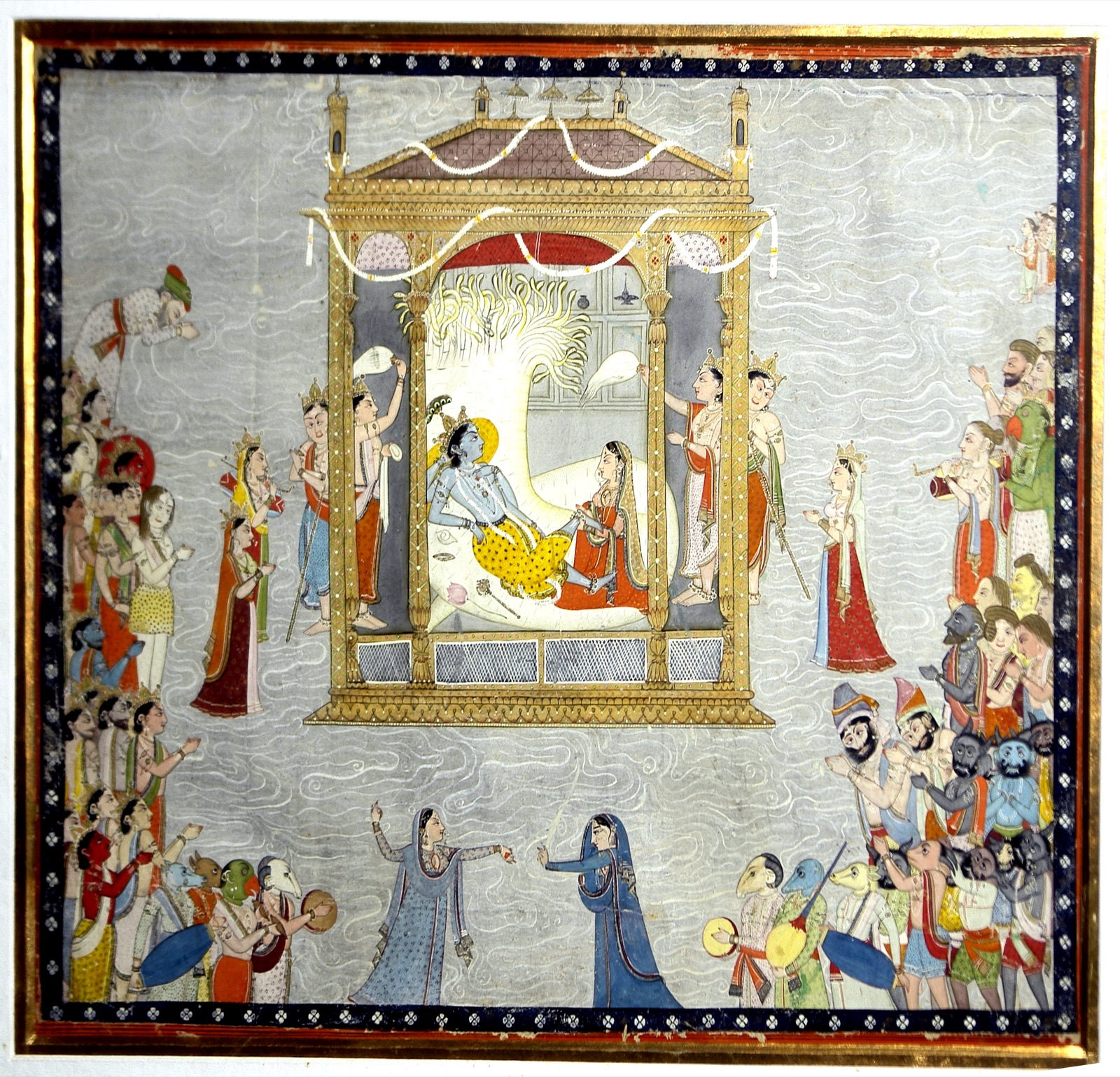
Historical painting of Lord Vishnu and Goddess Lakshmi on Ananta Shesha among devotees
Lord Vishnu and Goddess Lakshmi on Ananta Shesha · c. 1810 · Public domain

Gajendra's prayer

An elephant king discovers that strength cannot answer every struggle.

In the account of Gajendra Moksha, Gajendra leads his herd to a lake. A crocodile catches his foot as he enters the water. The elephant fights, and the struggle continues so long that his own strength begins to leave him. The other elephants cannot free him.

At this limit, Gajendra remembers a prayer from an earlier life. He turns his attention away from the contest and calls upon the supreme refuge. The Bhagavata Purana describes Lord Vishnu arriving on Garuda and releasing him. The narrative then reveals earlier lives of both Gajendra and the crocodile, giving the encounter a wider moral frame than a simple rescue scene.

The story is beloved because it makes surrender concrete. Gajendra does what he can. When effort is exhausted, his remembered devotion remains. Readers differ in how they understand the theology, but the moment of prayer is central to the tale.

For reflection

What changes when Gajendra moves from relying on strength to asking for help?

Prahlada and Narasimha

A child refuses to believe that power decides where the divine may be found.

Prahlada grows up in the household of Hiranyakashipu, a ruler who demands complete obedience. Prahlada's devotion to Lord Vishnu angers his father. Teachers, threats and punishments fail to turn the boy away from what he believes.

Hiranyakashipu finally asks whether Lord Vishnu is present in a pillar before them. Prahlada answers that Lord Vishnu is present everywhere. When the ruler strikes the pillar, Narasimha appears: neither simply human nor simply lion. In the Purana's telling, the form answers the ruler's attempt to make himself invulnerable through carefully framed conditions.

The episode is remembered as a protection story, but it also asks how faith can persist under pressure and whether authority has limits. The following chapter turns from confrontation to Prahlada's prayers, a reminder that the story is as much about devotion as about victory.

For reflection

Prahlada sees strength as coming from a source shared by all. How does that challenge his father's idea of power?

Dhruva's search

A child begins by seeking recognition and finds something deeper.

Dhruva is hurt when he is turned away from his father's lap. His mother Suniti points him toward Lord Vishnu, and he leaves for the forest. There he meets Narada, who first tests the young boy's resolve and then gives him a path of disciplined remembrance.

Dhruva's practice is described in extraordinary terms. When Lord Vishnu appears, the boy's desire has changed. The prize that first drove him into the forest no longer seems large enough. Later chapters follow Dhruva's life as a ruler and the consequences of anger, so his story does not end with a single vision.

The name Dhruva is associated with steadfastness and the pole star. The story invites readers to notice how an honest but narrow desire can be transformed through practice, guidance and a wider understanding of one's place in the world.

For reflection

Which part of Dhruva's wish changes, and which part of his determination stays with him?

The churning of the ocean

The search for amrita brings rivals together and reveals far more than they expected.

In the Samudra Manthana narrative, the devas and asuras agree to churn the Ocean of Milk. Mount Mandara serves as the churning rod and Vasuki as the rope. When the mountain cannot remain steady, Lord Vishnu supports it as Kurma, the tortoise. Their shared effort releases many things, including a dangerous poison, precious beings and treasures.

Among those who emerge is Lakshmi. The chapters describe her choosing Lord Vishnu. Dhanvantari appears with amrita, and the struggle over it continues; Lord Vishnu later takes the form of Mohini. The story has several scenes and should not be reduced to a single image of the mountain.

It is a narrative of cooperation under tension, of consequences that arrive before the desired reward, and of sustaining support that may be hidden beneath visible action. Different tellings emphasize different parts of the episode.

For reflection

What does the emergence of poison before nectar say about difficult collective work?